The sharp increase in commodity prices on account of the Russia-Ukraine war has put automakers in a fix. After the frequent price hikes in the current fiscal, manufacturers fear that any more price increases may further dent the already weak demand in certain segments. "We have taken several hikes and cannot immediately do it again. "We will have to closely watch the situation and act accordingly," said an official at an auto firm, declining to be identified. Even for companies like Tata Motors Passenger Vehicles, which has had a strong volume run and a robust order book, passing on the entire costs has been tough.

Taking advantage of a Russian offer to sell its crude oil cheap and bear the cost of insurance and transportation, India may import as much as 2 million tonnes (mt), or roughly 15 million barrels of crude, from the sanctioned nation in 2022, Business Standard has learnt. This comes after reports that Indian Oil Corporation (IOC) bought 3 million barrels of Russian Urals from trader Vitol for May delivery. This will be on cost, insurance and freight (CIF) model, where the seller incurs the costs and pays the freight, including insurance charges.

Size matters on the road. Small is not dominating India's car market any more. The share of cars priced up to Rs 5 lakh in the passenger vehicle market has fallen to 10.5 per cent in the first 11 months of 2021-22, compared with 26 per cent in 2018-19 (FY19), the lowest in four years, according to data from industry sources. Even the share of those in the price range between Rs 5 lakh and Rs 7.5 lakh has dropped to 32.4 per cent in the same period, from 34.9 per cent.

The Tata group flagship has sold more sport utility vehicles (SUVs) in the domestic PV market in the past four months than any other automotive manufacturer, cementing its no.1 spot. It first grabbed pole position in the SUV segment in October 2021 after the launch of the Punch - a sub-compact SUV offering.

The Centre's ambitious Rs 6-trillion National Monetisation Pipeline (NMP) could fall short of yearly targets for the current fiscal year (FY22) and the next one as well (FY23), partly due to the long gestation period in monetising big-ticket railway infrastructure, Business Standard has learnt from sources in the finance and rail ministries. Officials say the major chunk of railway monetisation will happen from FY24 onwards because leasing some of the infrastructure, like stadiums and dedicated freight corridor, will not happen anytime soon. Rail infra is expected to be the second-biggest contributor to the NMP, with about Rs 1.52 trillion worth of assets to be monetised.
The $8.5 billion TVS Group received final approval for a family resettlement on February 4 from the National Company Law Tribunal (NCLT). It is an arrangement that is noteworthy because unlike many other corporate settlements this one was sorted out amicably and without any open conflicts.

Stocks of Indian companies with exposure to Europe fell on Tuesday amid concerns about the impact on their sales in case the Russia-Ukraine crisis worsens and the US and its allies impose economic sanctions on Russia. While top conglomerates, including Reliance Industries, the Tata group, and Aditya Birla Group, said they did not have any significant exposure to Russia, executives of some of the oil and gas, pharmaceutical, and tea companies said they were monitoring the situation closely as they earned substantial income from the region. Russian President Vladimir Putin on Monday ordered troops into two breakaway regions of eastern Ukraine after announcing that Russia would recognise their independence.

Encouraged by a steady recovery seen in the first two weeks of February, hospitality firms expect the business hotels in metros including Mumbai, Bengaluru, Chennai, Kolkata and Hyderabad that have been lagging the leisure hotels in terms of revenue per available room (RevPar) to catch up in the coming months. Huge pent-up demand for MICE (meetings, incentives, conference and exhibitions) as companies slowly return to hosting physical events coupled with easing of the recently announced restrictions on international travel, will also help in getting closer to pre-Covid levels of revenue, they said. The Omicron wave that peaked in January had derailed the strong month-on-month recovery seen by the hotels since August.
As part of the exercise, each family will get complete ownership of the businesses it manages while scrapping the holding company.
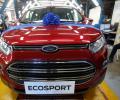
Ford, which had announced to quit the Indian market last year, said it was exploring the possibility of using one of its plants in India to produce electric cars for exports.

'We have all the technologies available, but it should be converted to something that can be commercially viable.'
After a very weak December quarter and a poor year-to-date fiscal year volumes-when sales plunged to the lowest in nine years, the signs in the first 15 days of January haven't been encouraging either. "Though the severity of the current wave is not as high as the previous one, it has hit the sentiments hard impacting conversion of enquiries into sales," said Vinkesh Gulati, president, Federation of Automobile Dealers Association (FADA).

Banks and companies in India are taking a cautious approach towards Sri Lanka, which, reeling from a financial crisis, has sought a $1-billion loan from the country to import essential commodities. A senior State Bank of India (SBI) executive said the bank was committed (to Sri Lanka) for the long term. "As far as exposures (are concerned), the bank will be cautious on its dollar exposure to Sri Lankan entities till the situation improves," he said.

After raising Rs 10 crore in seed funding last week from investors like Paytm founder Vijay Shekhar Sharma, Freshworks founder Girish Mathrabootham and Silicon Valley based venture capitalist firm Hourglass Venture, Chennai-based social media startup Pepul told Business Standard that it is looking to raise around Rs 200 crore by June this year for expansion. The social media platform, focused on online ethical practices, will be launched by 1,000 entrepreneurs across the country on January 26. Pepul, founded by G Suresh Kumar, will be using an Aadhaar-based user verification system to get rid of fake accounts on its platform. "We are planning to raise around Rs 200 crore by June this year.

In a bad start to the new year, hotels are counting their losses again. Weddings and corporate events for this month have either been called off or postponed. The blow has throttled the nascent recovery which had kicked in around August. It is primarily hurting the banquet-driven hotel chains, some of which are seeing cancellations running into lakhs for a single day.

'We were exporting copper at that time. Now India is importing copper to the tune of around $1.2 billion. Moreover, there was a larger impact on the dependent MSMEs.'

Kerala-based Kitex Garments, the world's second-largest children's garments producer, has landed in trouble after sporadic violence at its workers' camp led to an attack on the local police, injuring at least five officers. The local police told Business Standard that at least 156 migrant workers were detained after the incident and around 50 have been arrested so far. A decision on any possible action against the company will be taken after the investigation.

Factionalism between OP Panneerselvam and Edappadi Palaniswami, the dominance of the BJP, the ruling DMK having a strong face in the form of CM Stalin, 'community and region-based politics', corruption charges against former ministers, and lack of a proper ideology are the major challenges the party is facing in the state.

On the itinerary: Luxury camping, tribal homestays, heritage cities.

'Some of the launches may get deferred due to the semiconductor shortage, which is unlikely to get resolved before the second half of 2022.'
 © 2026 Rediff.com - Investor Information - Advertise with us - Disclaimer - Privacy Policy - Sitemap - Feedback - About us - Terms of use - Grievances